

Car Maintenance 101: The When, Why, and How of Oil Changes

Whether you’re a first-time car owner or a seasoned veteran, people typically fall on opposite ends of the car maintenance spectrum. Some are oblivious to tire pressure, oil life, and fluid levels until a weird symbol lights up on the digital cluster prompting them to drag out the owner’s manual or do a quick Google search of what the symbol means. Others are religious about regularly checking the tire pressure, monitoring the oil life, and keeping routine service appointments. Regardless of where you fall, every car owner should know the basics of a quick oil change and why oil changes are vital to your car’s longevity and your time on the road.
#1 The When: Knowing When It’s Time
How will you know when it’s time for an oil change? Most modern cars, trucks, and SUVs are equipped with technology or service reminders that alert you when your oil levels are low. The system monitors how many miles you’ve driven, your driving style, and how hard the vehicle is driven to determine the projected range. When you’ve met that range or your levels are low, the system will alert you with an oil life indicator on the digital cluster behind the steering wheel.
Before this technology became available, drivers relied on the vehicle’s owner’s manual, the holy grail of car maintenance. The owner’s manual outlines everything you need to know about your vehicle’s oil levels and the recommended service intervals. Go ahead, drag out your owner’s manual and look up the recommended interval for an oil change. If you just had your oil changed, then add the interval to your current mileage to determine when it’s time for your next oil change.
There are also other signs that your vehicle might need an oil change beyond the interval and the oil life indicator. Your engine may be noisier and knock, the vehicle may shake when it’s idling, or you may see excess vehicle exhaust. You may smell oil inside the car or find the oil is dark and dirty when you check the oil dipstick under the hood. Other indicators are rapidly falling oil levels, which signifies a leak, and a persistent check engine light.

#2 The Why: Knowing Why It’s Important
Think of your tires as the legs of your vehicle that make it move forward and backward. The oil, then, is the vehicle’s blood that pumps its heart or the engine. So, why does oil have to be changed if it’s just circulating through the engine?
Your car’s oil has three primary jobs – to lubricate, clean, and cool. The oil lubricates and cleans the engine’s pistons, valves, and other parts that move at high rates of speed when the engine is running. This movement creates friction and excessive heat that can deteriorate the engine if it isn’t properly cooled. By lubricating these parts, the oil cools the engine and its parts to reduce friction and over-heating.
While it lubricates and cools the engine and the moving parts, the oil is also busy cleaning the components of dirt and debris. These particles can corrode the engine and lead to expensive repairs. To mitigate this corrosion, the oil absorbs this debris and eventually breaks down, turning it into sludge. When oil turns to sludge, it’s less capable of doing its job, which is why routine oil changes are vital to extending the longevity of your engine.
Oil is also a key component in your vehicle’s efficiency or your gas mileage. Think about how hard your engine has to work to move the components at the right intervals to propel the vehicle forward down the highway. Now, think about this movement without any lubrication to help the parts glide or work together. Your engine is forced to work even harder, and that means greater fuel consumption. With clean oil and the right amount of oil, the components are properly lubricated, and your engine works more efficiently.
#3 The How: The Basics of an Oil Change
Changing the oil in your vehicle might sound like an overwhelming task, but it’s one of the easiest parts of car maintenance that you can do at home with the right tools. An oil change requires draining the old oil from the vehicle and replacing it with new oil. Simple, right? The process is the same whether you do it yourself or take your vehicle to your local dealership.
You’ll first need to lift the vehicle with a floor jack or a lift (used by many service technicians) so that you have plenty of room to work under the vehicle. Once lifted and secured, refer to your owner’s manual to locate the oil pan and filter. You may have to remove the undertray that protects these components from hazards on the road. Once removed, grab a container to catch the old oil and pull the plug on the oil reservoir. The oil will start to drain; allow it to drain until it slows to a trickle.
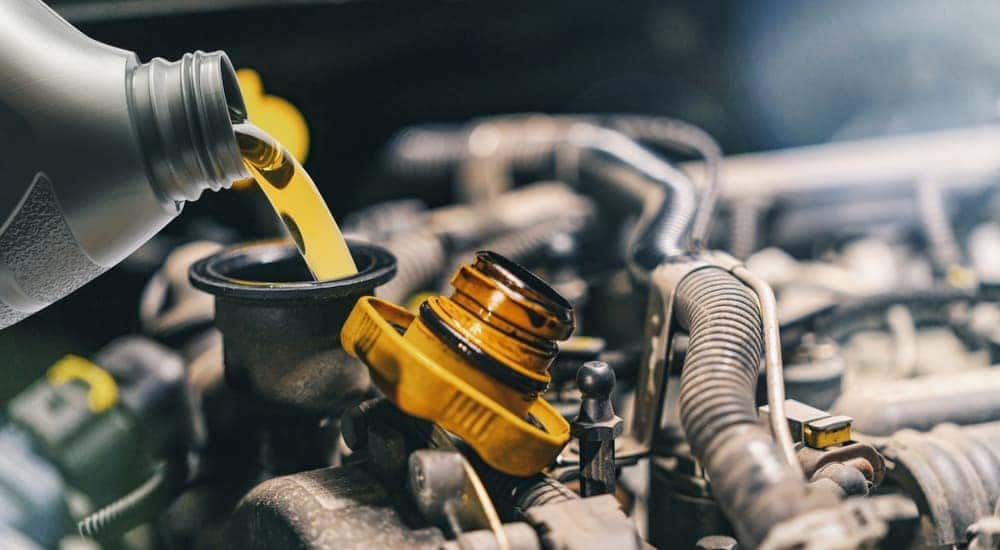
Find and remove the oil filter, letting the excess oil drain into the receptacle. As you remove the filter, make sure you remove the old oil-filter gasket or O-ring. Let the oil drain, and then replace the filter. Apply a light coat of oil to the gasket and the top of the filter to ensure a good seal. Once the plug is in, and the filter is secure, open the hood of the car, remove the oil cap, and use a funnel to fill the reservoir with the new oil. Check the oil level and for any leaks before closing the hood and lowering the vehicle.
#4 The Type: Oil Types
Changing the oil in your vehicle is fairly straightforward, especially with your owner’s manual at hand. Your owner’s manual outlines everything you need to know about your vehicle, from where the oil pan is located to the type of filter and the type of oil needed. This is why it’s important to always refer to the manual when it’s time for any type of repair.
Engine oil comes in four basic types – full synthetic, synthetic blend, conventional, and high mileage. Conventional motor oil is the most common, while high-mileage motor oil is designed for cars that have logged over 75,000 miles as this type of oil minimizes leaks and reduces emissions. Full synthetic motor oil is the most expensive oil you can buy and is ideal for optimal performance, extreme temperatures, and towing or hauling. Synthetic blend oil is a happy medium that offers many perks of full synthetic motor oil at a fraction of the cost. A blend of synthetic and conventional oil, it’s more expensive than conventional oil, but it can improve efficiency and performance.
#5 The Big Picture
Can you hear the rev of your engine? That rev is made possible by the oil, the bloodline of the many moving valves, pistons, and parts that work together to deliver the power you need to get from Point A to Point B. Without the oil; your engine would overheat from the friction caused by its many moving parts.
Knowing the role that the oil in your vehicle plays is integral to your vehicle’s longevity and the freedom that you have when you’re behind the wheel. An oil change can mean the difference between a safe and fun family vacation to the beach and an afternoon spent stuck on the side of the road with nowhere to go and an overheated engine. This is the big picture, and it’s why oil changes should be at the forefront of your vehicle’s maintenance routine.
Putting It Into Practice
Now that you know the why, when, and how of oil changes, are you ready to put what you learned into practice? For starters, ask yourself where you fall on the spectrum of car maintenance. Do you wait until a symbol lights up on your instrument display, or are you a fanatic about routine check-ups? Wherever you fall on the spectrum, grab the holy grail of car maintenance – your owner’s manual – and put what you’ve learned here into practice.

0 comment(s) so far on Car Maintenance 101: The When, Why, and How of Oil Changes