

Welcome to EVs 101: Choosing Between BEVs, PHEVs, and HEVs
Automotive jargon is inundated with acronyms and foreign words that can be difficult to wade through. If this seems to be the theme as you search for an EV dealership near me, you’re not alone. We’re the first to admit that the industry is laden with language that’s not always easy to understand, and the burgeoning segment of electric vehicles is adding to that exponentially.
Your search for an EV dealership has likely shown you that the term “EV” is a broad descriptor akin to how we use the word “SUV” to describe crossovers and SUVs of different sizes. Unfortunately, in the case of EVs, acronyms like BEV, PHEV, and HEV add confusion to inexperienced drivers; they seem more fitting for a futuristic cartoon like The Jetsons or a sci-fi flick like Transformers. Fortunately, we’re here to make shopping for an EV less intimidating by taking you behind the scenes and explaining the core differences between BEVs, PHEVs, and HEVs. Are you ready? Class is in session!
Battery Electric Vehicle (BEV): All-Electric Driving
One of the biggest hurdles in shopping for an electric vehicle is demystifying the acronyms. For example, BEV stands for “Battery Electric Vehicle” and is exactly as the name implies. It’s a vehicle powered strictly by a battery, meaning that it doesn’t run on traditional fuel. Think of the BEV as an EV that produces zero emissions and requires recharging rather than refueling.
Since BEVs rely on electric power, they’re typically built on EV-specific platforms that better accommodate their design. For example, think about what you find when you pop the hood of a traditional gas or diesel vehicle––an internal combustion engine. However, this isn’t the case on a BEV since the battery is typically located under the floor, freeing up the engine bay. Under the hood, you will find an electric motor rather than an engine, and some manufacturers use the available room to move critical components like the air conditioner further forward to increase the size of the cabin.
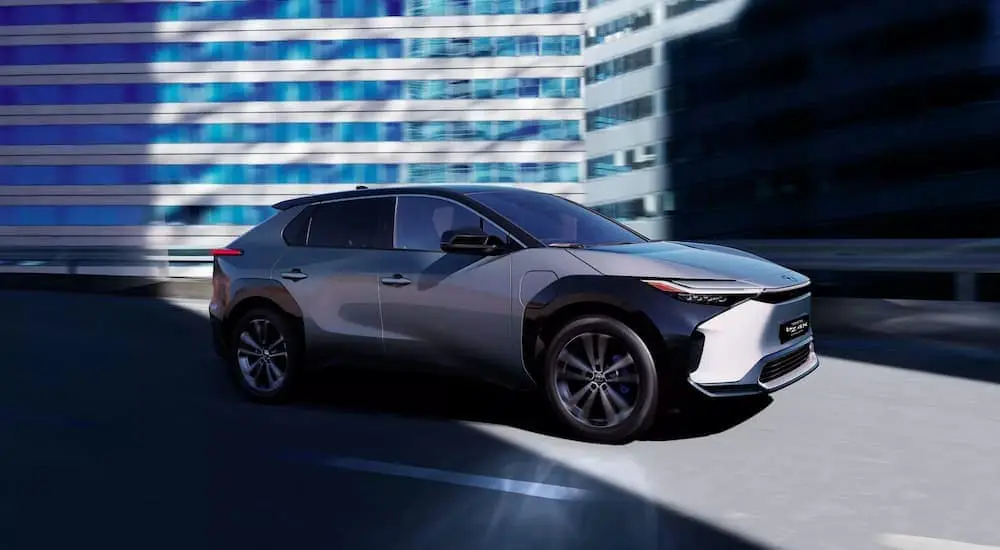
One of the newest entries into the BEV segment is the Toyota bZ4X, which will debut in 2023 and is built on Toyota’s all-new BEV-dedicated e-TNGA platform. The bZ4X marks the first in Toyota’s global “Beyond Zero” series and reflects its promise to expand the Toyota lineup to include 70 electric vehicles by 2025. The bZ4X is an exceptional start with its futuristic design both inside and out. Its electric powertrain is just as impressive and delivers up to 214 horsepower and an acceleration of 0 to 60 mph in just 6.5 seconds. This all-electric power doesn’t sacrifice efficiency, with the bZ4X offering up to a 252-mile range on a single charge.
Recharging a BEV like the bZ4X is easy as it comes with multiple levels of charging capability. For bZ4X drivers, Toyota makes it convenient to adopt an all-electric lifestyle and equips the SUV with a Combined Charging System (CSS) socket that readies it for charging at home and on the road. At home, the 6.6 kW onboard charger can recharge the battery in nine hours, equivalent to adding 25 miles of range per hour of charging. On the road, the bZ4X comes with 12 months of unlimited charging at EVgo charging stations nationwide, which are easy to find using the Toyota app on your smartphone.
Plug-In Hybrid Electric Vehicles (PHEV): The Best of Both Worlds
Now that you know what EV stands for, it makes sense that PHEV stands for “Plug-In Hybrid Electric Vehicle.” PHEVs give you the best of both worlds by pairing a traditional internal combustion engine with a battery and electric motor. As a result, PHEVs have both a gas tank and a charging port. However, unlike traditional hybrid vehicles, PHEVs typically have a larger battery and electric motor, making them more powerful and efficient.
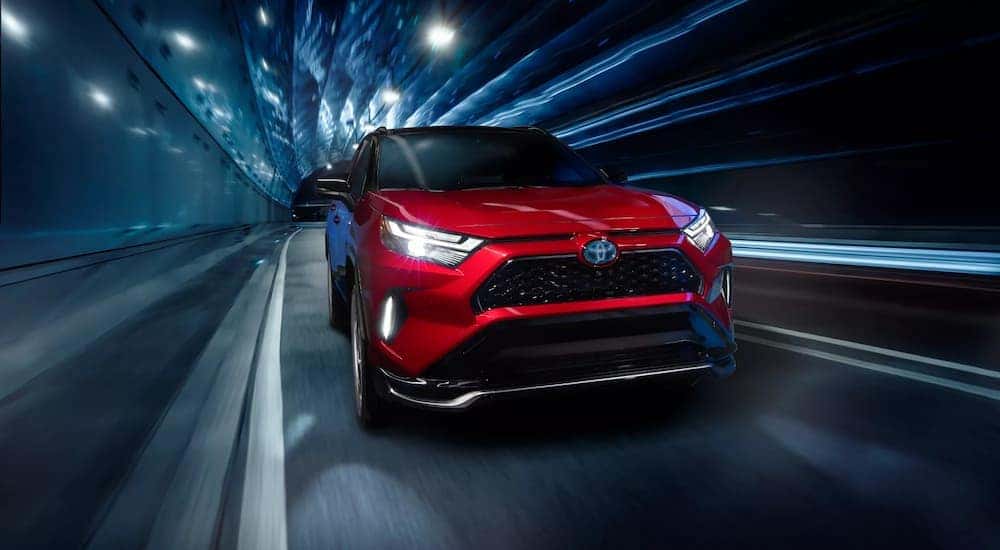
The advantage to owning a PHEV is that you aren’t solely relying on electric power, which gives you a little more room to roam. For example, if you’re driving a BEV like the Toyota bZ4X out of town, knowing your driving range and planning your route to the next charging station is vital. However, if you’re driving a PHEV like the Toyota RAV4 Prime, you can go anywhere because the RAV4 runs on both battery power and fuel. Once you deplete the battery on a PHEV, it drives like a standard hybrid and optimizes efficiency.
What does this efficiency look like in real life? The 2022 RAV4 Prime is powered by a 2.5L four-cylinder engine and electric motor that delivers 302 combined net horsepower and a launch from 0 to 60 mph in 5.4 seconds. The RAV4 Prime’s immediate acceleration makes it fun to drive, while its larger battery and electric motor explain its electric fuel economy of 94 MPGe. The RAV4’s gas-only fuel economy is just as impressive and averages 38 MPG.
Hybrid Electric Vehicles (HEV): Proven and Efficient
You’ve likely guessed that HEV stands for “Hybrid Electric Vehicle.” HEVs like the Prius deserve most of the credit for ushering the automotive industry into a greener future with zero emissions. As their name implies, they are low-emission models that rely on both an electric motor and a gas-powered engine. However, unlike their PHEV counterparts, they can’t be plugged in to recharge. Instead, all their energy comes from fuel.
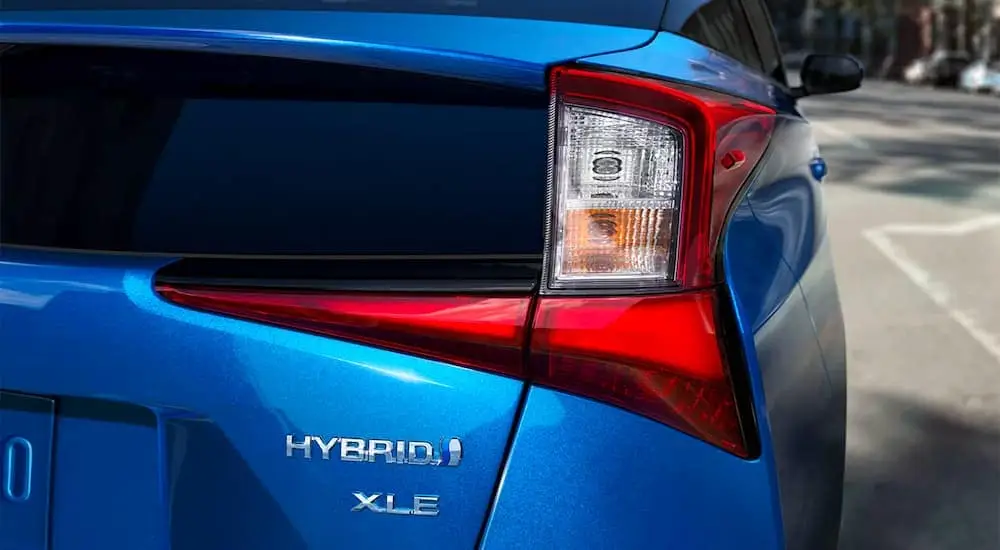
There’s no better example of a hybrid than Toyota’s legendary Prius. The Prius was the first mass-produced hybrid vehicle and introduced drivers worldwide to hybrid technology in the late 1990s. Today, the 2022 Prius continues that legacy as one of the most recognizable and most affordable hybrids in the segment.
Beyond its iconic silhouette, the Prius is powered by a high-efficiency 1.8L Atkinson-cycle four-cylinder engine and two motor generators that deliver 121 horsepower and 120 lb-ft of torque. Considering the Prius’ compact size, this power is impressive and explains its agile handling and maneuverability. Of course, its hybrid powertrain plays an integral part in its efficiency, with models getting up to 58 MPG in the city and 53 MPG on the highway. While the Prius still runs strictly on fuel, its efficiency is something to be considered because it means spending less at the pump and more on your next adventure.
Weighing Your Options
Shopping for an EV is like everything else in life––your experience depends on your approach and perspective. If you go into the process overwhelmed by your options, narrowing your choices can seem like a daunting and never-ending task. However, going into the process with curiosity and an open mind lets you discover everything the EV segment offers, from fully electric models like BEVs to HEVs and PHEVs.
As you start your search, we encourage you to take your time and look at your driving habits. Consider the advantages and disadvantages of the different types of EVs to determine the best option for your needs. For example, are you ready to jump fully into an electric lifestyle and commit to recharging your EV at home and on the road? Or, are you more apt to test the waters with a hybrid or plug-in hybrid before going all-in? Whatever you decide, Toyota makes adopting an electric lifestyle convenient and stress-free by giving you a long list of options so that you can find an EV that meets all your needs.

0 comment(s) so far on Welcome to EVs 101: Choosing Between BEVs, PHEVs, and HEVs