

Uncompromised Greatness: A History of the Toyota Camry

The Toyota Camry has a long-standing reputation as one of the most reliable and dependable automobiles on the road. Chances are, if you’ve ever been at a Toyota dealership, you’ve more than likely noticed one and might have even thought about getting behind the wheel. While the Camry generates high ratings and accolades from automotive publications and consumers alike, the history of this vehicle is just as fascinating as its reputation might suggest. Entering production in the 1970s, the Camry, which translates to ‘crown’ in Japanese, has captured the attention of millions ever since it first began rolling into Toyota Camry dealerships nearly 50 years ago.
A Rough Start in America
The lineage of Toyota’s golden child traces all the way back to the mid-1950s. In 1955, the Toyopet Crown began production in response to the ongoing need for public transportation in Japan. The Crown would go on to become the first Toyota exported to the United States, first appearing in 1958. While Toyota has gone on to become a great success here in the states, its early days were a matter of trial and error. To gain popularity, a cross-country endurance test with the new “baby Cadillac,” as it was sometimes called, was scheduled. Beginning in Los Angeles, the event would end when the new import barely limped its way into Las Vegas, far short of its intended destination of New York City.
Sales were minimal at best, and a substantial profit loss would lead to production being suspended in 1960. Luckily for Toyota and the rest of the world, it would be innovation that would see the car become resurrected. It was during the Japanese economic miracle of the 1960s that led to a major infrastructure change that included new roads. In order to adapt to these changes, Toyota shifted towards manufacturing smaller passenger vehicles. The resulting vehicles were the Corona and Corolla, which began appearing in 1957 and 1960, respectively. Throughout The 1960s and into the 1970s, Toyota continued its innovation and knack for top-tier engineering. And once again, it would be the necessity of innovation that would bring about a major change.
In the 1970s, the United States found itself in the midst of a massive gas crisis. Most American-made cars up until this point were equipped with ineffective engines as far as fuel economy was concerned. This would eventually lead to a public outcry for smaller vehicles that could go further on less fuel. While the American car companies were not ready for such a drastic change, the Japanese were, as they had previously repurposed their car designs to coincide with the change in the country’s infrastructure. However, progress was hindered as the United States enacted stricter import laws to protect the profits of their domestic manufacturers.
The Camry Arrives
Because the economy is built upon the principle of supply and demand, the public’s need for fuel-efficient vehicles couldn’t be ignored forever for the sake of profit. Toyota began to set up manufacturing plants stateside and agreed to place a limitation on the number of imports coming in. As the 1970s drew to a close, a new model of Toyota would appear. Originally called the Celica Camry, the four-door sedan made its first appearance in 1979. The Celica Camry would be in production for the next few years until ceasing in 1982. The four-door sedan was equipped with an inline 4-cylinder engine and, unlike the modern Camry, had rear-wheel drive as opposed to front-wheel drive.
The first generation of the Toyota Camry proper first began rolling off the assembly lines at the Tsutsumi manufacturing plant in 1982. The Camry I, or V10 as it was called, might not have had the formidable horsepower of some of its contemporaries but proved to be effective at fuel efficiency and have a decent amount of space for the time period. Arriving in the states in January of 1983, it didn’t take long for American consumers to warm up to Toyota’s newest import, and in a time span of fewer than two years, there were over 100,000 Camrys in driveways of American homes. The V10 model would stay in production until 1986 when the V20 debuted in Japan.
The V20 Camry proved to be reliable, popular, and featured Toyota entering the station wagon market. Throughout the 1980s, the station wagon was considered by many to be the ideal family vehicle. This era of the Camry also introduced options for a powerful V6 engine and all-wheel drive. This generation of the Camry proved to be one of the longest-lasting cars on the road, with some still being used even after 300,000 miles worth of wear and tear. The V20 Camry had overall improvements in performance as well, with higher HP than its predecessor.
The improvements to the Camry continued well into the 1990s. One of the new innovations during this time period would be the Camry Solara. This two-door coupe was introduced as a means of competing with the Honda Accord Coupe and even came in a convertible model. While only lasting for a short time before being rebranded as simply the Solara, it was one more sign of Toyota’s willingness and ability to adapt to changing trends in the automotive industry. 1997 would bring about a seismic shift in manufacturing. As Toyota unveiled the Prius, the first gasoline-electric hybrid vehicle to be mass-produced, the way people thought about fuel-efficient automobiles would be changed forever. Since then, manufacturers have shifted their focus towards electric vehicles as the collective focus of the world has become more eco-friendly.

The Modern Camry
The Toyota Camry would be no exception to this new direction as the new millennium began. In 2006, Toyota unveiled the Camry XV40, the first Camry to be equipped with hybrid technology. Powered by Toyota’s Hybrid Synergy Drive, this new Camry surpassed all others in fuel efficiency and was rated for 34 MPG combined. Of course, the Camry also continued to offer its traditional I-4 engine, providing affordable and efficient performance. While the innovations of the XV40 were astounding, this time period saw the rise of the SUV, and the Camry began to be sidelined by the popular Toyota RAV4.
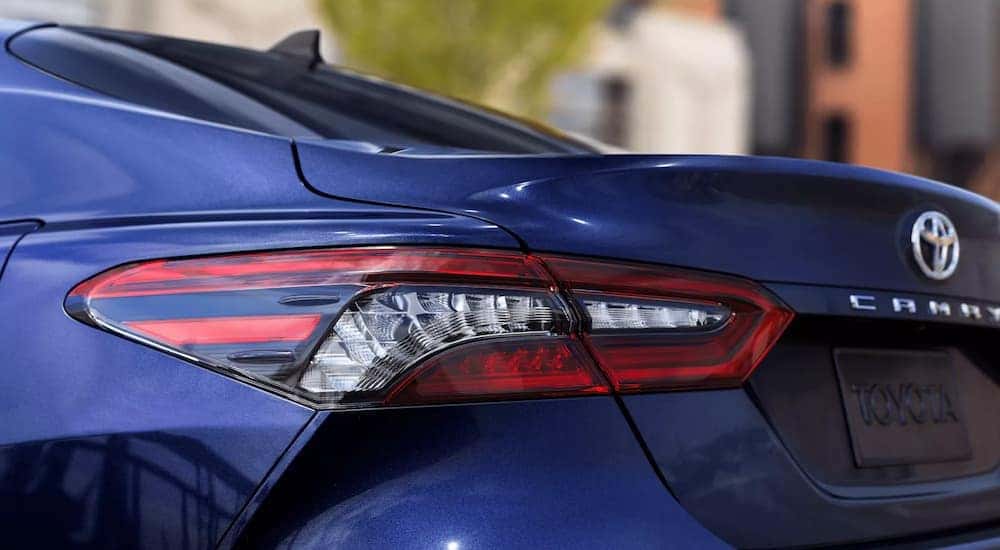
Despite these shifting market trends, Toyota persevered, and in 2017 introduced the eighth and current model, the XV70. The newest incarnation of the Camry appears to cater to the wants and needs of every consumer imaginable. For those who favor performance, the XV40 boasts an impressive 3.5L V6 engine with 301 horsepower, and is even available in a TRD version tuned by Toyota’s performance arm. Customers who want the most for their mileage will also be satisfied with the hybrid option offering 52 MPG combined. There is even an available all-wheel drive powertrain giving the Camry SUV-like performance in bad weather.
What’s Next For the Camry?
Because trends come and go, it’s almost impossible to foresee what direction the Camry will go in next. As the model continues to be the best-selling midsize sedan in North America, it appears that Toyota will maintain this space and continue to innovate and outperform many of its competitors. Should another event take place that causes turmoil in the automotive world, Toyota will certainly adapt. They’ve always been able to do so.

0 comment(s) so far on Uncompromised Greatness: A History of the Toyota Camry