

Here’s Why Your Car’s Engine Needs Synthetic Motor Oil

Are you looking for an oil change in Romeoville? Be careful where you bring your car because sometimes the most convenient option isn’t always the best one. Many national oil change chains advertise ultra-low prices, but what they don’t tell you is they’re probably using generic aftermarket filters and lower quality engine oil – oil that in some cases can void your warranty.
The old adage you get what you pay for applies to oil changes, too. Today’s complex, high-output motors require quality oil and filters to perform optimally and ensure a long, trouble-free life. While it might seem like all oil changes are alike, in fact, nothing could be further from the truth. Your car is one of the biggest investments you’ll make, so don’t trust it to just anyone.
To illustrate the importance of high-quality oil, it helps to get a clearer picture of how complex your engine really is and how the components work together to power your vehicle. Your engine’s multiple components rely on clean oil to keep them lubricated, free from friction, and cool. Keep reading to learn why clean engine oil is essential to keep your car’s engine healthy.
The Architecture of an Engine
In 2016, Toyota announced its newest line of engines, Dynamic Force Engines, a series of lighter weight direct-injection gas-powered motors designed to optimize both performance and fuel efficiency. These complex engines are comprised of intake and exhaust valves, cylinder heads, pumps, thermostats, and valves, all specially designed to achieve one goal: high thermal efficiency.
Put simply, thermal efficiency determines fuel consumption and output. It’s all about achieving the right mix of air and fuel and efficiently injecting that mix into the engine cylinders while also keeping the engine cool and well lubricated, which is where oil and oil pressure come in. Without high-quality motor oil, these complex systems will eventually break down, resulting in substantial decreases in performance and fuel efficiency.
All the engine technology in the world doesn’t matter much without motor oil. Just like human beings need blood in our veins to survive, your vehicle’s engine relies on oil to keep running. Motor oil performs a long list of functions, including removing dirt and debris, protecting the engine from temperature fluctuations, and even contributing to fuel efficiency, and clean, high-quality oil does the job better and more thoroughly.
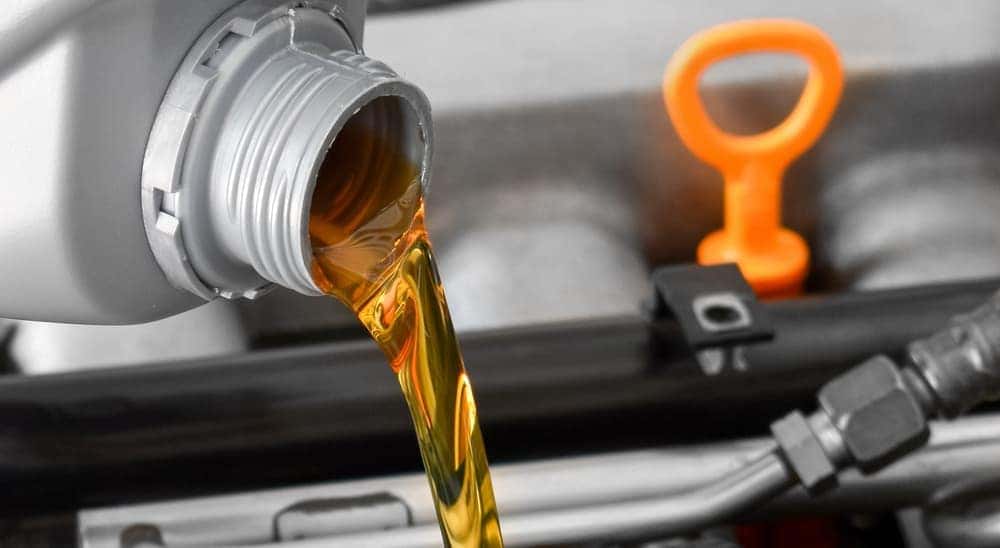
When your car isn’t running, motor oil sits in an oil pan. When you turn the key (or push the start button), it immediately goes to work, thanks to an oil pump that sends the oil through a filter and distributes it to moving engine components, including the crankshaft and bearings. As the oil does its job – cooling, lubricating, and reducing friction – it cycles back into the oil pan, and the process starts again.
Why Synthetic Motor Oil?
Because the same few quarts of oil continuously cycle through the engine every time you drive it, it’s not hard to see how it can break down over time. Over and over, the oil runs through your engine, and when your vehicle’s not in use, it sits idle in a pan. It’s no wonder high-quality synthetic motor oil is preferred by Toyota technicians and the factory.
Synthetic oil is chemically engineered, so its molecules are uniform in size. It’s designed with a high viscosity index, which means it performs well in both heat and cold. When it’s cold, oil needs to be thinner to move easily through your engine, and when it’s hot, a thicker (more viscous) consistency helps protect hotter engine components.
Think of viscosity this way: maple syrup is highly viscous (thick), and water has a low viscosity (thin). If you heat maple syrup in the microwave, it becomes thinner. If you put water in the freezer, it thickens into ice. Synthetic motor oil’s high viscosity index means it weathers temperature extremes without losing or gaining viscosity in response to extreme temperature changes.
Because synthetic oil is engineered oil, it doesn’t include impurities commonly found in blends and conventional motor oil. The impurities can break down over time and leave deposits and sludge on and in your engine’s components which may lead to engine knocking or even cause overheating. Additionally, your engine may burn more oil, requiring frequent top-offs.
What About Turbocharged Motors?
Many modern engines incorporate one or more turbochargers. Manufacturers use turbochargers to efficiently boost horsepower and torque without expanding the size of the motor. Because they’re lightweight and efficient, smaller motors translate into higher fuel economy ratings and lower emissions, which helps automakers meet stringent state and federal standards.
You may have noticed that even bulky full-size trucks like the 2022 Tundra are ditching big V8 motors for smaller, more fuel-efficient six-cylinder engines. How can such a small engine power a loaded pickup truck or one that’s hauling a boat or RV? The answer: turbochargers. Toyota’s i-FORCE 3.5-liter V6 and hybrid i-FORCE MAX engines feature twin-turbo architecture, and the latter delivers enough power to tow up to 12,000 pounds.
Turbochargers work by capturing engine exhaust and using it to spin a set of turbine blades, which suck in ambient air. The air is compressed to increase oxygen density, and that dense air is then forced into the cylinders of the engine, where it is ignited. The used air then leaves via the exhaust pipes, starting the cycle over again.
Turbochargers make for extremely efficient engines because they only activate when you need added power. This effectively increases or decreases the engine size depending on what driving conditions require. However, turbocharged engines rely on clean, high-quality synthetic motor oil to perform optimally. If you drive a newer Toyota vehicle, be sure to check your owner’s manual. Many models now require synthetic oil, and if you don’t use it, you can void the manufacturer’s warranty.

Hedge Your Bet: Use Synthetic Oil
Regardless of your engine’s specific architecture or the age of your car, most automotive experts agree that using synthetic oil will prolong its life. Not only that, but you’ll get better fuel economy and performance out of your vehicle. Using another human analogy, you’ll feel better drinking a green smoothie or eating a salad than you will chowing down on a fast-food burger and fries.
Just as it matters what you put in your body, it matters what you put in your vehicle’s engine. We have the ability to keep our cars running for hundreds of thousands of miles. Advancements in both engine and motor oil quality mean you’re changing your oil less frequently while enjoying more miles of optimal performance – but only if you choose high-quality oil.
This simple, routine service that takes under an hour is the key to keeping your vehicle’s engine protected from excess wear. When you receive an oil change from a Toyota-certified technician, you won’t ever have to worry about oil and filter quality. Simply check your odometer – and your owner’s manual – and make sure your engine receives the TLC it needs.
Staying proactive about engine care is the best way to ensure years of problem-free driving. These days, all it takes to keep your engine healthy is going online, scheduling an appointment, and allowing about an hour to get it done. Since synthetic oil is so high quality, many modern vehicles only require an oil change once every 10,000 miles. With as little as one hour every year, your engine will be primed for years of maintenance-free driving enjoyment.

1 comment(s) so far on Here’s Why Your Car’s Engine Needs Synthetic Motor Oil
It’s interesting to know that we can enjoy the optimal performance with the advancements in the engine and motor quality these days. I hope that is the case with the secondhand vehicle that I bought even if it is a small one, but it was just used for a year by the previous owner. It would probably help me if I look for a small engine service professional to give me advice and information regarding the care and performance of this vehicle.